
Vertical B-Roll for Reels, Shorts and TikTok: Where to Find It
Cropping landscape b-roll to 9:16 throws away two thirds of the frame. Where to find vertical b-roll shot that way, when a crop is fine, and what works in short form.
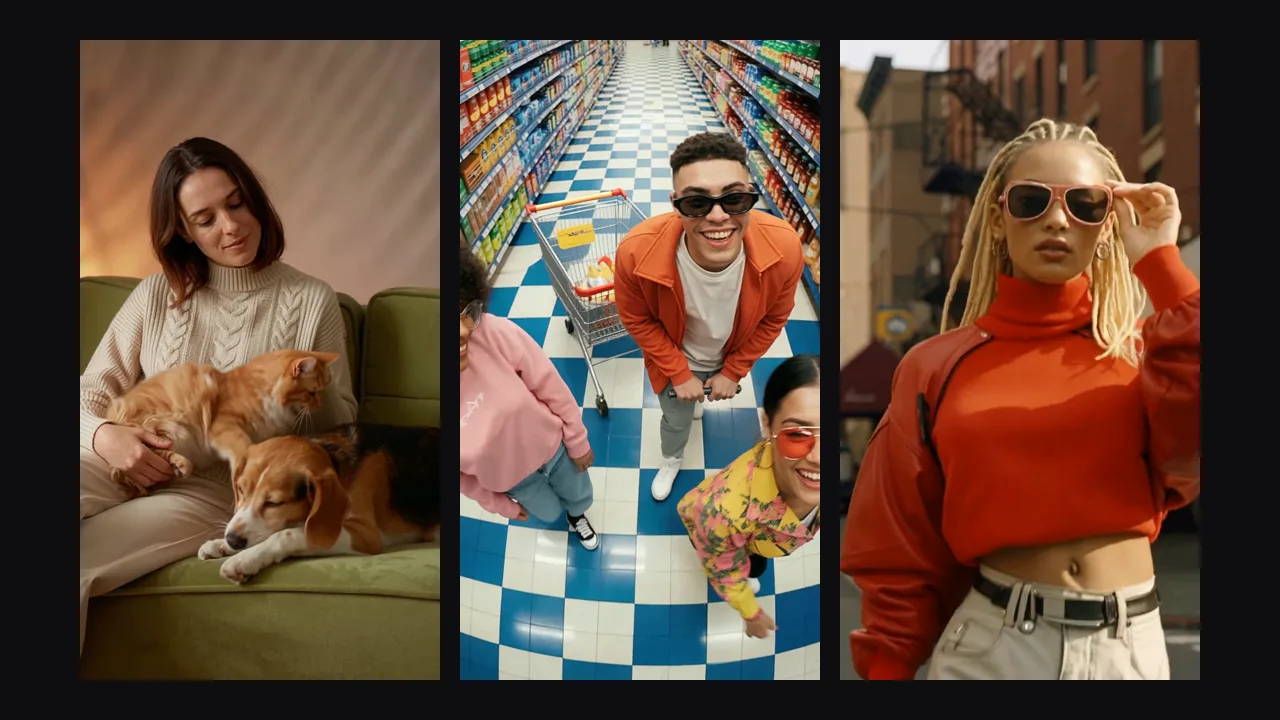
The short version. Almost every stock library was built landscape, so most "vertical b-roll" is a 16:9 clip cropped down — which throws away about two thirds of the frame and puts the subject in the wrong place. A crop works when the source is 4K and the subject happens to sit centre; below that you are upscaling a 607-pixel-wide strip to fill a 1080-wide feed. Filter for native vertical where the library supports it, shoot your own for anything specific, and generate the shots that neither route covers.
Why cropping landscape b-roll usually fails
The maths is worse than it looks
Take a standard 1920×1080 piece of b-roll and crop it to 9:16. You keep the full height, so the width becomes 1080 × 9/16 = 608 pixels. That is 32% of the original frame — you have thrown away roughly two thirds of the picture.
Then that 608-pixel-wide strip has to fill a feed that expects 1080 across. You are upscaling by 78%, which is where the softness comes from. On a phone, next to native vertical b-roll, it reads as slightly mushy even to viewers who could not tell you why.
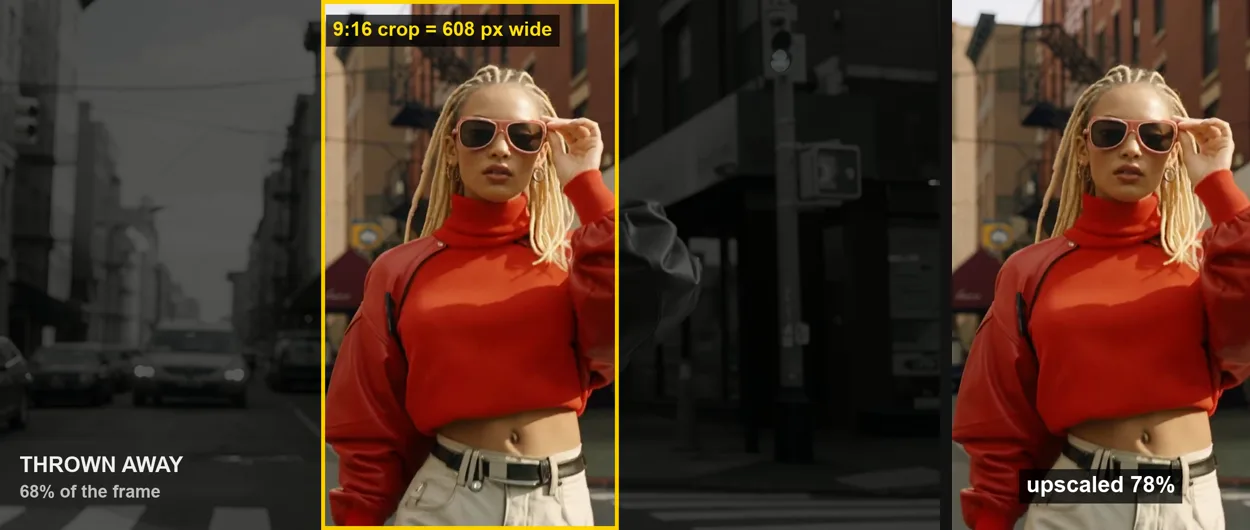
The exception, and it is a useful one: a 4K source (3840×2160) cropped to 9:16 gives you 1215×2160. That is comfortably above 1080×1920, so no upscaling at all. If your library lets you filter for 4K, cropping becomes a genuine option rather than a compromise.
Composition does not survive the crop
The bigger problem is not resolution. Landscape b-roll is composed for a landscape frame — the subject sits on a third, there is negative space to one side, the horizon is placed for a wide picture. Crop the sides off and the subject lands dead centre, the breathing room disappears, and any camera movement that tracked across the frame now tracks out of it.
B-roll shot vertically is framed for the tall crop: the subject placed for a portrait frame, movement running up and down rather than left to right, headroom that still works when the frame is three times taller than it is wide.
Vertical b-roll gets less room than the platform suggests
Reels, Shorts and TikTok all put your vertical b-roll under text overlays, a caption block, a profile picture and a stack of interface. The safe area is much smaller than the video. B-roll that already lost its composition to a crop, then loses another 20% behind the UI, has very little frame left doing any work.
Where to find vertical b-roll that was shot vertical
Filter, do not search. Pexels and Pixabay both hold genuinely vertical b-roll and both let you filter by orientation. The filter matters more than the search term — searching "vertical b-roll" gets you b-roll tagged that way, filtering gets you everything actually shot that way, which is a much bigger pool.
Check the paid libraries' vertical collections. Most of the subscription services now maintain vertical b-roll sets, though they are consistently thinner than their landscape catalogues. This is the gap the market has noticed: at least one new marketplace has launched positioning itself explicitly as vertical-first for short-form creators, on the argument that generic landscape b-roll "gives you objects" when short form needs moments.
Shoot your own, because vertical is the easy case. This is the one format where DIY genuinely competes. A phone shoots native 4K vertical, and the shots short form actually needs — hands doing something, a walk, a desk, a street — need no crew and no permits. Creators who build a small personal vertical library stop competing for the same twelve b-roll clips everyone else filtered down to.
Check the source before you commit. If a library only offers your shot in 1080p landscape, crop it and accept the softness, or find another shot. Do not upscale a 608-pixel strip and hope.
What b-roll actually works in short form
Sourcing is half of it. The other half is knowing what the format wants.
With vertical b-roll, the first second decides everything
Short form has no patience. The opening frame is doing retention work before your first sentence lands, which means the strongest vertical b-roll goes at the top, not saved for the middle. A held establishing shot that would open a YouTube video is a scroll-past here.
Cut faster than feels comfortable
Long-form b-roll can breathe for four or five seconds. In a Reel it is closer to one or two — the cut itself is part of the pacing. This changes what you source: you need more b-roll of shorter length, not fewer clips you plan to hold.
In vertical b-roll, motion beats beauty
A beautifully composed static shot underperforms a mediocre one with movement in it. Something entering frame, hands doing a task, a walk, a pour, a reveal. On a feed that is scrolled with a thumb, movement is what stops the thumb.
Vertical b-roll ideas that consistently work
Hands completing a task in one continuous take · a walk-in or walk-out to open · over-the-shoulder screen shots for anything digital · pouring, cutting, assembling — any process with an obvious beginning and end · a close-up of the thing you are talking about, shot much closer than feels necessary · a location establishing shot held for exactly one second.
When to generate instead
Two situations where sourcing vertical b-roll from a library reliably fails.
Nobody shot it vertically. The subject is niche enough that even the landscape library is thin, so the vertical b-roll set has nothing at all — most B2B subjects, specific products, unusual processes.
You need a consistent run. Five vertical shots that look like one shoot, rather than five clips from five different cameras, colourists and days. Cutting between mismatched vertical b-roll is far more obvious in short form than long, because the cuts come faster.
ClipBee generates natively at 9:16 rather than cropping a landscape render down, so the framing is composed for the tall frame from the start, and a style setting keeps a run of b-roll visually consistent. Commercial use is included on every clip, which matters when the Reel becomes an ad.
For the general sourcing workflow, see how to find b-roll footage. For the licensing side once a video is monetised or promoted, see can you use stock footage on YouTube.
FAQ
What resolution should vertical b-roll be? For vertical b-roll, 1080×1920 is the baseline every platform accepts. Source at 4K vertical (2160×3840) when you can — it gives you room to punch in or stabilise without going soft.
Can I just crop landscape b-roll to vertical? Cropping works if the source b-roll is 4K and the subject sits centre-frame. From a 1080p source you keep only a 608-pixel-wide strip and have to upscale it, which is visibly soft next to native vertical clips.
Is b-roll different for Reels than for TikTok? The b-roll is interchangeable; the safe area is not. Each platform puts its interface in slightly different places, so keep the important part of the frame centred and away from the bottom third, and one clip works across all three.
How long should each vertical b-roll clip be in a Reel? One to two seconds for most cuts. Short form uses the cut as pacing, so source more b-roll of shorter duration rather than fewer you intend to hold.
Where can I find free vertical b-roll? Pexels and Pixabay both have real vertical b-roll libraries — use the orientation filter rather than searching for the word "vertical". Expect overlap with everyone else in your niche, since the free vertical pool is much smaller than the landscape one.